
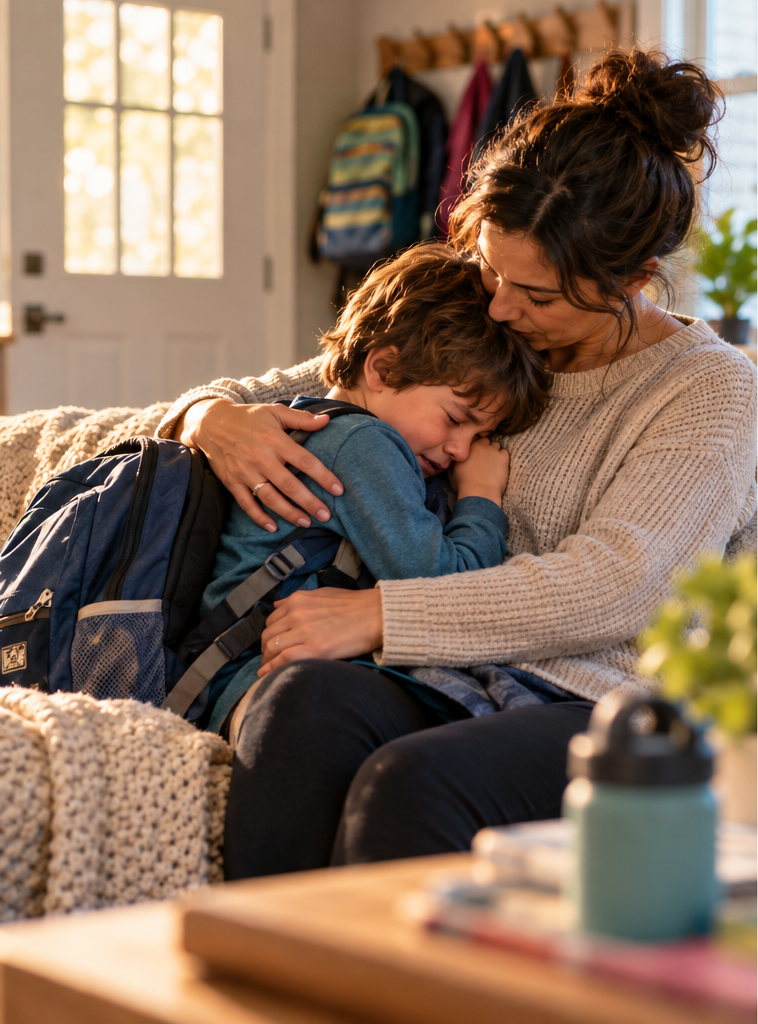
Understanding emotional exhaustion, sensory overload, and the importance of creating a softer transition home.
Excerpt: Your child may hold everything together at school, only to fall apart the moment they get home. Discover why after-school meltdowns happen, what they can tell us about your child's needs, and how small changes can make afternoons feel more manageable.
When the School Day Ends, the Feelings Begin
Picture this.
Your child has just returned home from school. Their teacher mentioned they had a wonderful day. They followed directions, completed activities, and participated with their classmates.
But within minutes of walking through the front door, everything changes.
They're crying because their shoes won't come off. They become upset when you ask about homework. Maybe they're yelling, hiding underneath a blanket, refusing conversation, or reacting strongly to something that normally wouldn't bother them.
You might find yourself wondering, How could they have such a good day at school and such a difficult afternoon at home?
For many families, especially those raising neurodivergent children, this experience is familiar.
There may be more happening beneath the surface than what we see.
At Path & Petal, we encourage families to approach these moments with curiosity before conclusions. Rather than immediately asking how to stop a behavior, we can begin by asking what the child may have experienced throughout the day.
Understanding After-School Restraint Collapse
After-school restraint collapse is a term used to describe the emotional release some children experience after spending hours managing expectations, transitions, social interactions, and environmental demands.
The term is associated with parenting educator and psychotherapist Andrea Loewen Nair. It describes a recognizable experience rather than a medical diagnosis.
Throughout the school day, children may be working hard to:
- Follow classroom routines and instructions.
- Navigate friendships and social expectations.
- Manage noise, lighting, crowds, and other sensory experiences.
- Move between activities, sometimes with little preparation.
- Communicate their wants, needs, and frustrations.
- Remain attentive even when tired or uncomfortable.
Some children may also be masking—consciously or unconsciously suppressing their natural responses or differences to meet social expectations.
By the time they arrive home, their capacity to manage additional demands may be significantly reduced.
What appears to be an overreaction may be a response to an accumulation of stress.
Importantly, a child seeming calm at school does not automatically mean school was comfortable for them. Neither does every difficult afternoon mean a child was masking or experienced restraint collapse.
Understanding the individual child is what matters.
Why This May Look Different for Neurodivergent Children
For children with autism, ADHD, sensory processing differences, or communication challenges, everyday school experiences may require substantial effort.
Consider a child who is sensitive to loud sounds.
They may spend the day surrounded by classroom conversations, bells, cafeteria noise, and crowded hallways. Even if they participate successfully, managing that sensory input can be exhausting.
Another child may have difficulty with unexpected transitions. They might successfully move from one classroom activity to another while internally experiencing considerable anxiety.
A child who uses limited spoken language may spend much of the day trying to communicate needs that others do not always recognize.
When these children return home, they may need time to recover before they are ready for additional interaction.
Their responses might include crying, pacing, increased movement, withdrawal, repetitive movements, irritability, or seeking familiar objects.
These responses should not automatically be viewed as defiance.
They are opportunities to investigate whether a child's environment, expectations, communication access, or support needs could be adjusted.
Five Ways to Create a Gentler After-School Transition
1. Give Your Child Permission to Arrive Home Slowly
We often greet our children with questions because we want to connect.
"How was school?"
"Did you eat your lunch?"
"Do you have homework?"
Although these questions come from a loving place, answering them may feel like another assignment after a demanding day.
Consider replacing immediate questions with a simple welcome.
"I'm happy you're home."
Then allow your child to settle before expecting a conversation.
For a child who prefers minimal verbal interaction, a smile, wave, or familiar visual greeting may be enough.
Connection doesn't always require conversation.
2. Create a Predictable Decompression Routine
Some children benefit from knowing exactly what happens after school.
A transition routine might include:
Arrive home → Wash hands → Snack and water → Quiet or movement break → Check in → Next activity
This does not need to become a rigid schedule.
Instead, think of it as a familiar rhythm that helps your child anticipate what comes next.
For some children, the best transition includes sitting quietly with a favorite book.
Others may need movement, outdoor play, music, or time with a preferred activity.
A child who seeks sensory input may enjoy stretching, dancing, or playing with familiar sensory materials. A child who feels overwhelmed by sensory input may prefer dim lighting, fewer people, and reduced noise.
Offer choices whenever possible. Sensory preferences are individual, and no single strategy is right for every child.
3. Check for Basic Needs Before Addressing Behavior
A long school day can leave children hungry, thirsty, physically uncomfortable, or simply exhausted.
Before beginning a conversation about difficult behavior, consider whether your child needs something more immediate.
Have they eaten enough? Would they like water? Do they need the bathroom? Are their clothes uncomfortable? Have they had an opportunity to rest?
For children with communication differences, these needs may not always be expressed through speech.
Parents can offer familiar foods, visual choices, gestures, or communication devices to help children indicate what they need.
Addressing physical comfort will not prevent every meltdown, but it can remove unnecessary sources of stress.
4. Respond to the Feeling Without Ignoring Safety
When a child is overwhelmed, the goal is not to deliver a lengthy lesson in that moment.
The immediate priorities are safety, reducing distress, and helping the child regain a sense of stability.
You might say:
"I can see this is really hard right now."
"We can take some quiet time."
"I'm here if you need help."
For a child who does not communicate through speech, your response may be more about what you do than what you say.
Reduce unnecessary language. Provide access to their communication system. Respect their need for space. Offer familiar supports without forcing touch, eye contact, or conversation.
Emotional understanding does not mean that every action is safe or acceptable.
If a child is throwing objects or attempting to hurt themselves or someone else, calmly prioritize immediate safety. Move dangerous objects if you can do so safely, protect others, and seek individualized professional guidance when these situations recur.
Teaching and problem-solving are often more productive after the child has recovered.
5. Work With the School to Look for Patterns
If difficult afternoons happen regularly, it may help to observe what occurs before them.
Some questions worth exploring include:
- Does your child seem more overwhelmed on days with assemblies or schedule changes?
- Are afternoons harder when lunch is skipped?
- Does your child have reliable access to sensory breaks?
- Are they able to communicate discomfort or request help at school?
- Are there particular transitions or activities that appear especially demanding?
A simple observation log may reveal patterns.
For example, a parent might notice that afternoons are consistently more difficult after gym class or on days when the school bus arrives late.
This information can support collaborative conversations with teachers, therapists, and other professionals.
The goal is not to monitor every behavior or make the child responsible for adjusting to an unsupportive environment.
It is to identify opportunities for better support.
A Simple After-School Reset You Can Try
Here is one example of a flexible 30-minute transition. Adjust it to your child's age, preferences, and needs.
First 5 minutes: Welcome home
Offer a familiar greeting and allow your child to put their belongings down without immediate questions.
Next 10 minutes: Refuel
Offer water, a snack, and an opportunity to attend to personal needs.
Next 10 minutes: Decompress
Provide a choice between quiet time, a preferred activity, or movement.
Final 5 minutes: Reconnect
Ask whether your child is ready for the next part of the afternoon. A visual schedule or first-then board may help with this transition.
Some children need considerably longer than 30 minutes. Others may prefer a shorter routine. The timing is an example, not a rule or a treatment protocol.
When Additional Support May Be Helpful
Occasional difficult afternoons can be part of childhood. However, frequent or severe distress deserves attention.
Consider speaking with your child's pediatrician or relevant support professionals when:
- Episodes regularly involve injury or significant safety concerns.
- Your child appears persistently distressed about attending school.
- Changes in sleep, eating, communication, or functioning accompany the behavior.
- Your child experiences ongoing anxiety or difficulty recovering.
- Current strategies do not appear to meet their needs.
Educators, occupational therapists, speech-language pathologists, psychologists, and other qualified professionals may offer different perspectives depending on the concern.
Families can also ask the school about environmental adjustments, communication accommodations, and individualized supports.
A Gentle Reminder for Parents
A child's behavior after school does not tell the entire story of their day.
Neither does a teacher's report that everything went well.
Both perspectives can be true, and both deserve attention.
Your child may have worked incredibly hard to navigate an environment that required more from them than anyone realized.
Sometimes the most helpful thing we can offer is not another instruction, another question, or another expectation.
Sometimes it is a familiar place to rest, a little more time, and the reassurance that their needs matter.
At Path & Petal, we believe understanding often begins when we become curious about what lies beneath the surface.
Because children deserve support not only when they are struggling visibly, but also when they have been working quietly to hold everything together.
Helping families find their way forward.
References & Further Reading
Cook, K. (2026, October 10). How to manage after-school restraint collapse. Psychology Today. https://www.psychologytoday.com/us/blog/parenting-redefined/202610/how-to-manage-after-school-restraint-collapse
Belsky, G. (2026, August 5). Restraint collapse: Why kids fall apart after school. Understood.org. https://www.understood.org/en/articles/restraint-collapse-why-kids-fall-apart-after-school
Gilgoff, R., & Bhushan, D. Why kids act out: Tips to help your child cope with stress. American Academy of Pediatrics, HealthyChildren.org. https://www.healthychildren.org/English/healthy-living/emotional-wellness/Building-Resilience/Pages/why-kids-act-out-tips-to-help-your-child-cope-with-stress.aspx
Educational note: This article is intended for general parent education and does not replace individualized developmental, medical, or mental health guidance.